
Trigonometry seems to be my biggest math knowledge gap going into Calculus. When I started about a month ago, I knew almost none of it. I have a mix of recollections from around the time I should have learned it, though I think most of what I remember was actually picked up later from my time in the Air Force. It was part of my job at the time, and to some extent, I would sometimes use DMS to denote direction. That Degrees Minutes Seconds, or a way of expressing precise degrees in what I think is more readable than standard decimal degrees. There was another alternative degree system that I think was called Mils? Two L’s, maybe? I don’t recall. That was mostly for artillery, which I didn’t run into very often. I think I mostly used it in a tactics and strategy class. Also, that was a long time ago, and memory fades and all that. But it doesn’t matter anymore, at least not to me, so let’s move on.
I could vaguely recall some of my high school Geometry, but I didn’t have any of the triangle stuff internalized. The triangle stuff turns out to be the whole game, really. As an aside, I think the rest of my Geometry is also pretty weak, so I’ll want to spend some quality time reviewing that stuff this summer as well. I think I might have mentioned that in my Algebra review, but it’s worth saying again now. I’m certain it will continue to come up, and I should really know it.
So far, my Trig review has taken the same pattern for every single lesson. First, I start studying the thing and it makes sense. Then I try to work it through and find that I have absolutely no idea what anything is. Then I really start to worry that my attempt at Calculus will end before it actually begins. Then I bang my head against the materials for a while and kinda start to get how to use it. Then something bonkers happens and the abstract nonsense becomes extremely obvious and I feel a little dumb for not noticing it before. Then I do some practice problems, perform quite well on them, and feel unreasonably smart for it. Rinse, repeat.
The biggest revelation thus far has come from Radians, which I’m still not sure I 100% understand. I’m going to shove in a book definition:
“One radian is defined as the angle at the center of a circle in a plane that is subtended by an arc whose length equals the radius of the circle.”
-some wikipedia-assed jazz (https://en.wikipedia.org/wiki/Radian)
I think this kinda makes sense when I picture a unit circle. Like, the radius is 1, definitionally, so the arc that matches this is also the length of 1. I think this might be how we arrive at π, because half of a circle’s circumference is a single π. Three lengths of 1 unit doesn’t quite make it around half, six lengths of 1 doesn’t quite make it around the whole circle, that’s what π is. π is the total number of radians, just over 3, that it takes to get around one half of the unit circle.
I’m still putting that together, but really, that one surface level idea, that half of a circle is a single π, completely opens up how to use Radians. 90° degrees is a quarter circle, and because we’re talking pi as a half circle, the 90° degree measure is actually just half. It’s half of half, right? So in radians, 90° degrees is pi/2. The 45°s are all multiples of pi/4. 60° degrees is a third of that top half, so three of those makes a full top half, so that’s a pi/3, and likewise, the 30° degree slice is a sixth of that top half, so it’s pi/6. So if you see 3pi/4, that’s three quarters of the top half, it’s 135° degrees. You dig?
One piece I’m having trouble with is a version of co-terminal angles. I get what one is, that’s cool. I get how you can start at one and then just add full revolutions to it to get another. It’s when the question starts with some high degree or radian and wants me to find a co-terminal in a specific range. I watched a video on it by Krista King today, and she sets it up like a multi-part problem, which I think I need to start using, because it makes perfect sense. She starts by setting up the revolutions as an algebraic problem, where:
= + n * 2
And then an inequality where the range becomes the ends, so if it’s between the alpha and beta in:
< + n * 2 <
This could really help me if I could just get it in my head and make it a part of my regular mathematical repertoire, so to speak. It needs to enter into my personal toolkit. I think I’m going to need to find some problems to solve with this.
Another piece that’s currently giving me a little trouble is that even though I can repeat and even logically understand that and how Cosine is my x and Sine is my y coordinate on a Cartesian plane, I keep mixing up the two when I go to do the work.
I can also see now, quite plainly, that lacking these and a handful more basic understandings are exactly why I struggled so hard in my high school AP Calculus class. I barely grasped the notion of the Unit Circle, of a Limit, of the ways that you can take known, related functions and formulas, and combine them in novel ways to extract or derive your critical unknowns. Looking back, it’s a wonder I made it anywhere in that class. Hopefully, I’m building a stronger foundation of knowledge and practical use, so that when I hit the point of needing to just have these, I just might have a chance.
I want to back up and chat about that one that clicked with me the other day some more, because it’s fantastic. So you may have seen some version of the wheels below – the first comes from a free cheat-sheet (https://tutorial.math.lamar.edu/Extras/CheatSheets_Tables.aspx#TrigSheet) on Paul’s Online Notes (https://tutorial.math.lamar.edu/), which is a great math resource. The second comes from the reading materials from the Modern States Precalculus course, which I think you need a login to see, but here’s the link anyway (https://learn.modernstates.org/content/enforced/6898-Precalculus-2025-Lumi/docs/reading/unit-3/Precalculus_3_1_2R.pdf?ou=6898). These are pictures of the Unit Circle, or a circle depicted on the Cartesian Coordinate Plane – the typical XY graph we were introduced to in high school math. This circle has a radius of 1, meaning that at x = 0, the circle intersects the y-axis at 1 and -1, and when y = 0, it intersects with 1 and -1 on the x-axis. In between each of these, the circle still has a radius of 1 (because it’s a circle), and the x + y still have to add up to reflect that. Look at the 45° angle. The related numbers on the wheels show you what the x and y coordinates of this angle do that, and also show the same degree measurement expressed in the radian measurement. This might be obvious to others, but I’ve needed to think about it for like, two weeks, and it’s finally become clear. A 45° angle is half of a 90° angle, which itself is half of the 180° angle, which itself is half of the whole circle, 360°. In radians, a circle is 2π. So working backwards, half of that is π, half of that is π/2, and half of that is π/4. If you want to make a half circle from 45° angles, it would take 4 of them. So a 45° angle is a quarter of a half circle, and since a half circle, in radians, is π, it actually makes perfect sense that 45° is exactly ¼ of π, which means π * ¼, or π/4. Man, that was a long walk, but I did finally get there.
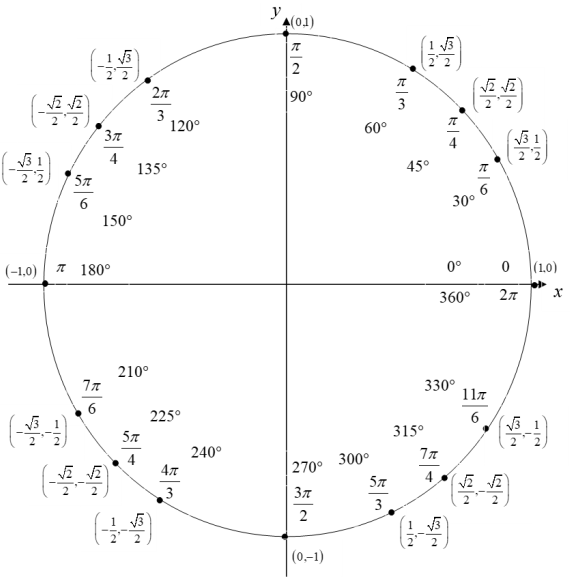
This is further bolstered by the conversion formula, which uses π/180° to move from degree to radians and using the inverse to get back again – a single π is 180°, as a ratio, or 180° degrees is a single π.
But the biggest extraction from this is when remembering that the Unit Circle has a radius of 1 unit, and that making right-triangles isn’t arbitrary, but rather a way of figuring out the coordinates on the plane of where the terminal ray intersects with the circumference of the circle. We can do this because our mathematical forebears figured out how to work out ratios of right triangles, and then figured out how to do it just off of the angles, and a right triangle built-in gives you one of three angles. Those three angles must add up to 180°, and the right angle means we can subtract 90° right away, leaving only a total of 90° between the remaining two angles! This shit is magic! Also, because of those ratios that we know, because we’ve figured out the whole Pythagorean of it all, AND because we KNOW that in the Unit Circle, the hypotenuse is and is always a length of 1, we know that a π/4 or 45° angle MUST have equal length sides, 1 = x2 + y2, or 1 = 2x2, so ½ = x2, and then you got your 2/2, after you rationalize the denominator. I’ve not yet internalized the coordinates of the 30°s and 60°s, it’s ½ and 3/2, which I think I’d do better with if I had a more visual understanding of square roots.
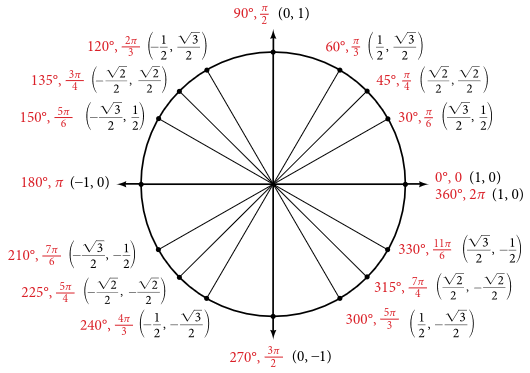
I say this because visualizing the angles as geometric and not as arithmetic have really helped me here. It’s like, if you know that 45° is a quarter of the half-pie, that pi is half a pie, that π/4 is a quarter of our base unit, then it means that four of these things fills that top half when moving in the positive directions (counter-clockwise) in standard position, so if you see a 5π/4, that means you already know where this is, because 4 quarters is 1, so this is one more quarter past that filled in top half! AAAAAHHH!!! Why didn’t I see this earlier?!?
Alright, anyway, I gotta mentally circle this thought a few more zillion times and then explode and think that I’m brilliant.
I’m gunna dig out my various text books and systematically run through the practice problems forwards and backwards until it makes me sick. I have to nail this thing.