
I think this is going to be the first installment in an ongoing, though inconsistent, series that digs into some of the lessons I’m picking up from my academic progress. I’m not sure if that means it’ll be an extension of the regular, weekly check-ins on this blog, though I suspect it’ll end up being something else over time. But this first one should at least be fairly related, because the math of it all is one of the top things on my mind in this project. It’s core to my main pursuits, which springs to mind another topic, on the conversations I’ve been having about those pursuits, school, advice. But that’s another topic for another day.
Let me see if I can speed-recap the situation – I decided to go back to school years ago, and I’m closer to actually following through on that than ever before. I’m still undecided on a major, but it’s seeming like something technical, in computer stuff or engineering, might be the best fit for me. The problem is, it’s a lot of math, and math is hard. So I’ve been taking math classes to get up to speed. I recently finished a College Algebra course from one of those self-paced, online course websites, one that could lead to actual college credit, previously did the same with Statistics, and now I’m doing a self-directed Pre-calculus stint to ramp up to Calculus, which is my biggest concern. I’m sure there will be more challenging classes ahead of me, but in my current state, this feels like the real challenge, or at the least the first real challenge, into this change.
Today I’m going to do a less-technical recap of some of the things that stuck out to me from that College Algebra class. It turns out that it covered more ground than my high school course, if I recall it well enough, and that extra ground filled in a big chunk of what I was struggling with when I took AP Calculus back in high school. First off, the course was a great refresher on the bits that I did learn but have had no reason to practice – all of the basic algebra principles, variables, order of operations, quadratics, all that stuff. This time around, I think I learned quadratics better than ever before. I still feel pretty weak on a few of the methods, like factoring by completing the square. I understand it in principle and have practiced it a little, but not nearly enough to internalize it or even know when it’s a good method to use. I think I’ll want to do that at some point, get in some real practice with it, that is. But I’m also not sure how useful it will actually be, and I am a little worried about misusing my limited time. It’s tough to get advice on the specifics, as I find people tend to forget just how much they’ve learned and focus on current problems, not the massive mental library they’ve been building for a lifetime. Maybe these are questions for professors and TAs when I’m actually in school.
Functions are a great example of my improving on previous knowledge. When I encountered them again this time around, it felt a little superfluous, like I didn’t really need to spend much time going over this again. You know, I get the “eff of ex”, that you have an input and an output, and all that jazz. But I quickly realized that I was very wrong, because going over it again gave me the chance to correct some misconceptions and lock in the correct principles, definitions, etc. Having these correct is key, because it turns out that a huge amount of the math that follows requires this, it’s like filling in the rest of a baseline of linguistic terminology, notation, and syntax that started way back in Elementary with your symbols for addition and subtraction. This became acutely apparent when I hit the sections on function composition.
Functions, if you aren’t familiar, are just another way to talk about equations, formulas, stuff like that. Actually, equations, formulas, and stuff like that are all their own, individual concepts, which overlap in meaningful ways, and learning about functions helps to fill those in, because some of these definitions are relative to each other. A function is a very specific type of these things, a mathematical expression with an independent variable acting as the input to which the expression renders one and only one output, the dependent variable. The “f of” is the result of passing a particular input through the function as described by its formula. This doesn’t need to go both ways, though, in other words, the output doesn’t need to map to just one potential input. Those exist, but they’re special and have their own name, 1-to-1 Functions. Functions also don’t need to be mathematical, and some of the metaphors presented in courses are actually, factually, just functions – the input always maps to an output and is consistent. In function composition, you take two or more functions and combine them. This is a process with its own methods, principles, and notations, but all previous knowledge of related topics still apply. For instance, the Order of Operations still matters, and more so now that you are combining functions which may each be composed of multiple operations. When I first approached function composition in high school, I saw it as a novelty, which I think it is often still presented as in lessons. I have to imagine it’s pretty tough to actually construct “real world examples”, because almost every class I’ve come across with even a smidge of math loves to use the same useless junk that I just can’t relate to. That’s unfair, I am familiar with pizzas and movie tickets. They just never make an impact on me. It’s never a problem that I’m feverishly trying to solve. Just how many burgers can I get if I skip two bus tickets? No. Not a thing. However, this time around, I could find my own connection. Almost all of my work since high school, from the Air Force, to retail, and especially my corporate job involved quite a bit of math. Because of those experiences, I could start to actually see and feel what it meant to compose functions, because I’d been doing some version of it in the work world.
My best example I have for other working professionals is the spreadsheet. If you’ve used Excel or any of the many substitutes, there is a good chance you’ve done this. It’s also a programming concept – you have an expression that takes an input and gives and output, if the output is consistent and predictable, than it can be used as the input to another expression that then provides its own output, and if they are related in such a way, you can combine them into a single, more elegant expression. You need to maintain your order of operations or you’ll fuck up the expression and it’ll calculate something you didn’t mean to, and you can apply your simplification knowledge to clean up extraneous parts. Think about nested If statements, which I’m guilty of overusing in my own spreadsheets. The output of the if is true or false, and depending on which it is, another function could convert that response into a more useful output, possibly by adding another “If”, something like “if true, add 1, else, 0”. You can set up a bunch of these from one cell into the next or, as you get better at it, learn to combine all of the relevant functions into one formula housed inside a single cell that gives you the only output that you actually care about.
I can relate that back and forth from practical to abstract and back again with Geometry, especially with how it integrates with Algebra. At some point, you’ll be asked to figure out the area of one of the faces of a box. You’ll be missing the length of at least one side, but you have enough information on the rest of the box – likely the area and two of the three sides you’d need to calculate it – that you can work your way backwards to the missing side. Now, I usually end up doing just that, laying out my various bits of knowledge and working through them from what I know towards the answer that I want, but if you’re particularly keen on the topic, you could combine all of this work into a single function. Whichever path you choose, the concept remains, and you’ll still have done it. It’s brilliant, really, you didn’t know it, but if you’ve been working through the math subjects in order (or gotten out to the real world to solve problems using the outputs as inputs), you’ve been composing functions all along.
So there’s one insight – Composite functions matter because as your mathematics study progresses, you’ll find a need to take related functions and combine them to create new functions.
Next up, I completely missed sequences and series in high school, which made AP Calculus nearly impossible. I simply could not comprehend entire swathes of problems presented to me because I’d never actually known these concepts, their applications, or notations. I got away with it for a little bit, because I could just mimic problems that looked similar enough. But I couldn’t comprehend the syntax or symbology, and as complexity increased, faking it simply didn’t work anymore. I was stuck, and I’d lacked the experience to find my way out of it. By the way, there are many ways to get stuck and each has their own way out. In a case like this one, the solution is to top and back up. I needed to go back to an earlier place in my learning, a place I understood well enough to continue learning and stop faking.
A sequence is a sort of succession of numbers, and while there may be more further on, at this level, there are two flavors. Because I revisited computer programming before revisiting Algebra, I now think of all of these as being something like a Recursive expression, which I do recognize is not quite right. I wouldn’t recommend you go into a test with that idea, but it works when I think about simple functions in something like the C language, where you might assign a starting number as “i = 1”, and then each time the function is called, it increments up because you’ve also assigned the task “i++”, which literally increments the starting number by one. You can change the starting number by changing what “i” is set to, like “i = 500”, and there are ways of modifying the syntax such that you can change the interval that is being incremented to 2, 3, or any number or ratio. You can even make the interval negative, and all of that is the same with arithmetic sequences. Common notation for this borrows from the logic of sets, where you put a dataset in curly brackets like {0,1,2}, or from more common function notation, like an = 2n, where n is the maximum number in the sequence.
The Factorial is a type of these that really helped me bridge the conceptual gap, because I’d seen them before and kinda sorta had a little bit of an idea of what they were, but I really didn’t know how to work with them other than very clunkily mashing my way through. So the notation is “n!”, same meaning for the “n” part, and this new notation of an exclamation point means the product of the positive consecutive integers from 1 to n. In other words, instead of counting up from 1 to n, you take each number in that sequence and multiply it with the previous result. 2! Is 2 * 1, which is just 2. I guess 1!, which is a little silly, doesn’t multiply, it’s just 1. Nothing to factor with it. 3! (which I think is pronounced “Three Factorial”), means 1 * 2 * 3. You can just multiply them all together, but you could also take each one at a time, or you know, in sequence. So 1 * 2 is 2, 2 * 3 is 6. What’s 4!? Just take the end result of the sequence immediately before it and multiply that by the next number in the sequence – 6 * 4, which equals 24. And now we start to notice that this can grow extremely quickly, and get an idea of just how that might look. Keeping in mind how to actually perform this is worthwhile, because you could end up with a rational that has factorials in both the numerator and the denominator, and remembering what composes this sequence means you can simplify the ration by canceling like terms. “5! / 4!” is just 5. (5 * 4 * 3 * 2 * 1) / (4 * 3 * 2 * 1), cancel like terms, you’re left with 5/1, and that’s 5. Done, no need to expand and slowly multiply that mess out. Extremely useful to know as those numbers get bigger.
This is a great entry for this type of math, because it hints at the underlying properties. Now we start getting notation like an = a1 + d(n-1), which is the explicit formula for an arithmetic sequence. An arithmetic sequence defines a sequence, or a set of numbers that changes with uniform increments, and that formula lets you find a specific number in that sequence. Same meaning of n, so if we’re looking for the tenth number in this sequence, that’s “a10”, and if you have the starting number, that’s “a”1, if you have the increment, that’s “d”. “d” can act like the slope of a more traditional linear equation and “a1“ as the intercept, if it helps. You multiply the increment “d” by “n-1” instead of “n” because you’ve already included the first number in the sequence as “a1”.
An arithmetic series expands on this idea by not just finding the specific number at a defined spot in the sequence, but sums everything in the sequence from the defined start to the defined stop. Sequences and series also come in Geometric flavor, and that’s multiplication stuff. The arithmetic flavor is about a common difference between increments, whereas the geometric version works with common ratios between terms. These get used for more specific problems, like compound interest, scientific scales for loudness or earthquake intensity, stuff that has a rate that you can reliably calculate. And these ultimately lead to the biggest knowledge gap that I had, which I now know as Summation Notation. I remember hitting the notation for this in that AP Calc class and just being so lost. It was the late 90s, so if I’d have known where to look, I could have found answers on the internet. But I didn’t and, to be honest, I also wasn’t all that interested. I had the text book, I could have just checked there – would have been nice to have had that thought back then.
You can find all types of diagrams for this type of thing online, I’m borrowing one from onelinemathlearning.com, I hope they don’t mind:
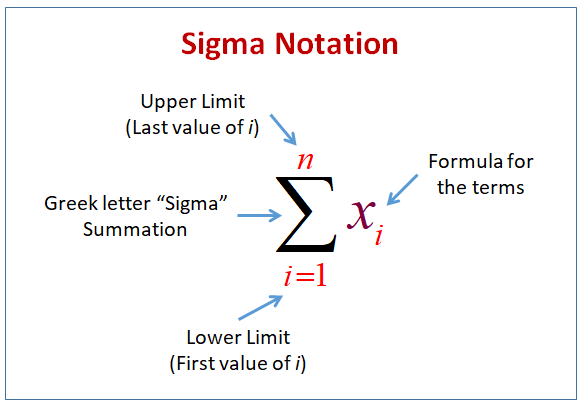
Just seeing something like this would have helped a ton when I was younger, but going through the course in order with fresh eyes now helped even more. It’s basically the same idea, but this notation more efficiently and compactly transmits the information. This one feels closer to the programming version, where the “i” at the bottom designates the starting point, the “n” up top tells us where to stop, and the junk to the right of the Sigma (the funky-ass E) is the actual function. It’s not always written exactly like this, sometimes the top and bottom are to the right in superscript and subscript, but it means the same thing. The big win was when I saw that you can throw an infinity symbol up top where that “n” indicates, which is for summing an infinite series.
A thing I sorta remember from Calculus is how we’d need to deal with the concept of infinity, but I don’t know that I ever really understood how or why. It looks like, at least the beginning of Calculus, is split into Integrals and Derivatives. I only vaguely remember either, and I’m certain I didn’t understand either, because when I see explanations of them now and know it is not at all how I understood them back then. But understanding how you could arrive at a precise solution by approaching infinitely smaller estimates makes sense now. This was also helped by the limit notation, where you can show how the dependent variable approaches but never arrives at a particular value as the independent variable approaches infinity. Pretty slick stuff.
I’ve glossed over a few of them, like toolkit functions. Honestly, I could use more practice with those as well. I think I’ll try to keep track of my weakest areas and then when I’m in between courses, I’ll see about finding some practice for them. But I think that’s a fair enough overview of some of the meaningful lessons I’ve gotten from Algebra today.
Next time, I’ll get into what I’ve been learning in the Trig module so far. It’s been a bunch, but I’m still pretty early.